At a glance
Natural Nantgwynant lake 2 miles from Beddgelert on an easy lakeside path — Dinas Emrys hillfort above (Merlin's dragons legend, National Trust), Snowdon ridgeline views. Sygun Copper Mine en route. Welsh Highland Railway to Beddgelert. Open at all times, free. LL55 4NE.
About Llyn Dinas
Llyn Dinas lies in the Nantgwynant valley 2 miles east of Beddgelert — a natural lake below the Snowdon massif, reached by an easy path along the valley floor through oak woodland. The lake is dominated by Dinas Emrys, the rocky wooded crag immediately above its northern shore: an Iron Age hillfort and early medieval site that is the setting for one of the most significant legends in Welsh mythology. According to the Mabinogion and associated traditions, this was where Merlin (Myrddin Emrys) revealed to the British king Vortigern the true reason for the nightly collapse of his fortress walls — two sleeping dragons, one red and one white, whose eventual battle resulted in the red dragon's victory and gave Wales its national symbol. Archaeological excavations in the 1950s confirmed early medieval occupation of the site.
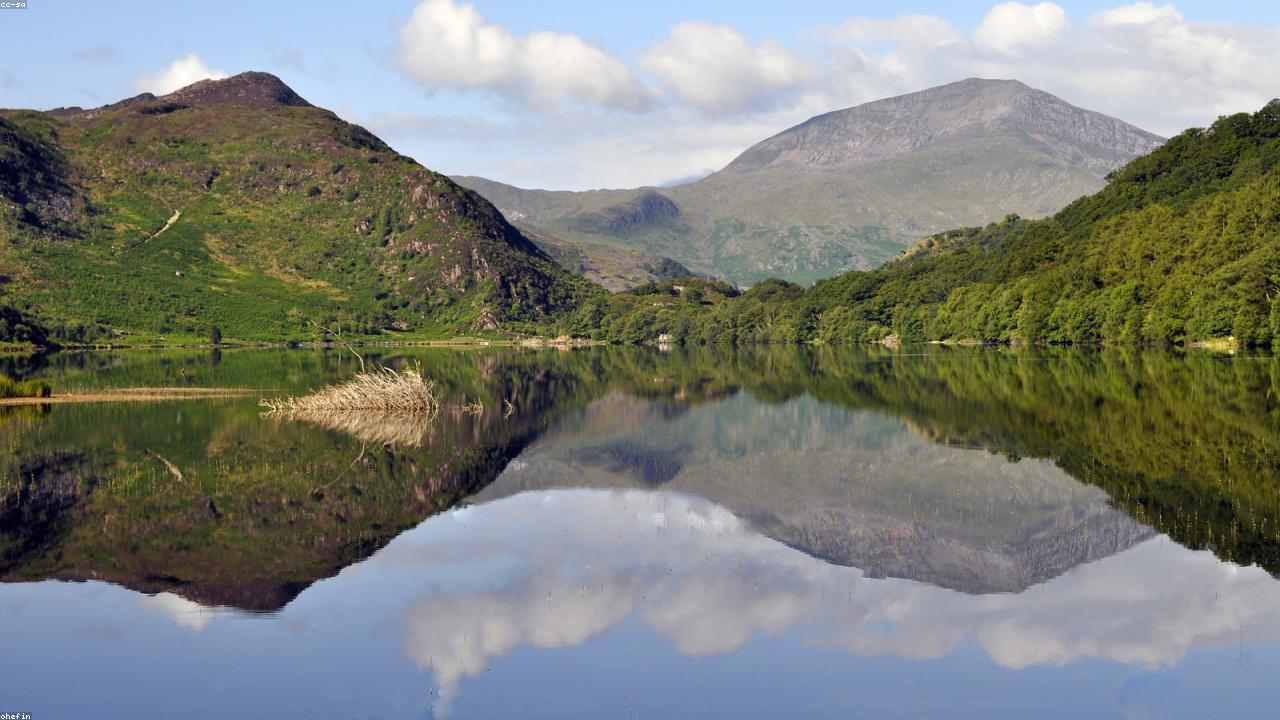
The lake itself is about half a mile long, clear, and set between the wooded valley walls and the steep south-western face of Moel Siabod on the far shore. Views across the water to the Snowdon ridgeline are among the best available from valley level in Snowdonia. The lakeside path runs along the northern shore; Dinas Emrys can be ascended by a steep rough path in 20–30 minutes from the lakeshore.
Sygun Copper Mine — a Victorian copper mine with self-guided audio tours through ore chambers with stalactites — is 0.5 miles from the lake on the Beddgelert approach. The Welsh Highland Railway serves Beddgelert (2 miles from the lake) from Caernarfon and Porthmadog. Llyn Gwynant (3 miles further east, designated wild swimming) is the natural extension of the same walk.
Find it on the map
Frequently asked questions
Dinas Emrys is the rocky wooded crag immediately above Llyn Dinas — a site that gives the lake much of its mythological resonance. According to the medieval Welsh Mabinogion and its associated traditions, the British king Vortigern (Gwrtheyrn) tried to build a fortress on the site but was frustrated by the nightly collapse of his walls. His magicians told him to find a boy without a father and sacrifice him; this boy turned out to be the young Merlin (Myrddin Emrys), who in turn revealed the true cause of the problem — a lake beneath the foundations containing two sleeping dragons, one red (representing the Britons) and one white (representing the Saxons). The red dragon woke and defeated the white dragon — the origin myth of the red dragon on the Welsh flag. The name "Dinas Emrys" (Fort of Ambrosius/Emrys) connects the site to Merlin's other identity as Ambrosius. Archaeological excavations have confirmed Iron Age and early medieval occupation of the site.
The most direct route from Beddgelert to Llyn Dinas follows the A498 road east for approximately 2 miles through the Nantgwynant valley. A footpath runs parallel to the road on the valley floor for much of the route, passing through woodland and along the river. The path is largely level, making it one of the most accessible lake walks in Snowdonia. The lake is reached at its western end; the lakeside path continues along the northern shore with views across the water to Dinas Emrys on the hillside above. Allow 45–60 minutes each way at a comfortable pace. Sygun Copper Mine (Victorian copper mine with self-guided audio tour) is passed on the approach, 0.5 miles from the lake. The walk can be done as a return journey or combined with a circular route.
Dinas Emrys hillfort is National Trust land — the rocky crag above Llyn Dinas. A path ascends from the lakeside or from the road, but it is steep and requires care. The ascent takes approximately 20–30 minutes from the lake shore. At the top, the remains of a small medieval building (possibly connected to the Arthurian traditions) and the outline of the Iron Age ramparts are visible; archaeological excavations in the 1950s revealed early medieval and Roman-period finds confirming occupation. The views from the summit of Dinas Emrys over the lake and down the Nantgwynant valley are excellent. The hillfort is not formally managed as a visitor attraction — there are no interpretation panels — but it is freely accessible on foot.
Llyn Dinas is used for wild swimming and is generally considered suitable — the water is clear and unpolluted, the lake is natural rather than a managed reservoir, and the access to the water's edge is straightforward from the lakeside path. It is not an officially designated wild swimming site, so there are no facilities or safety provisions. The water is cold (mountain-fed) and the lake is moderately deep. The larger Llyn Gwynant (3 miles further up the valley, with a National Trust campsite and established wild swimming) is more popular for swimming and has better shore access. For visitors primarily interested in swimming, Llyn Gwynant is the better choice; Llyn Dinas is more of a walking and scenery destination.
Llyn Dinas is good in all seasons, though the experience varies considerably. In spring and early summer, the oak woodland above the lake is vivid green and birdsong is intense; the water level is high and the Snowdon ridgeline is clear of snow. In high summer the valley is busy (Beddgelert and Nantgwynant attract large numbers of visitors) and parking is difficult; evening visits give the best light and fewer people. Autumn is arguably the most beautiful time — the oakwoods above the valley turn bronze and the low sun gives the lake surface a particular quality. Winter visits are peaceful but the path can be muddy and the shorter days limit the time available. The walk from Beddgelert is accessible year-round in good footwear.