At a glance
Flint (Y Fflint, CH6 5PE) — a Flintshire town on the Dee Estuary, built around the earliest of Edward I's Welsh castles (1277). Flint Castle ruins free (Cadw). Outstanding Dee Estuary birdwatching. Mainline train station: Chester (15 min), Rhyl (20 min), Holyhead. Level coastal walks. Town market Saturdays.
About Flint
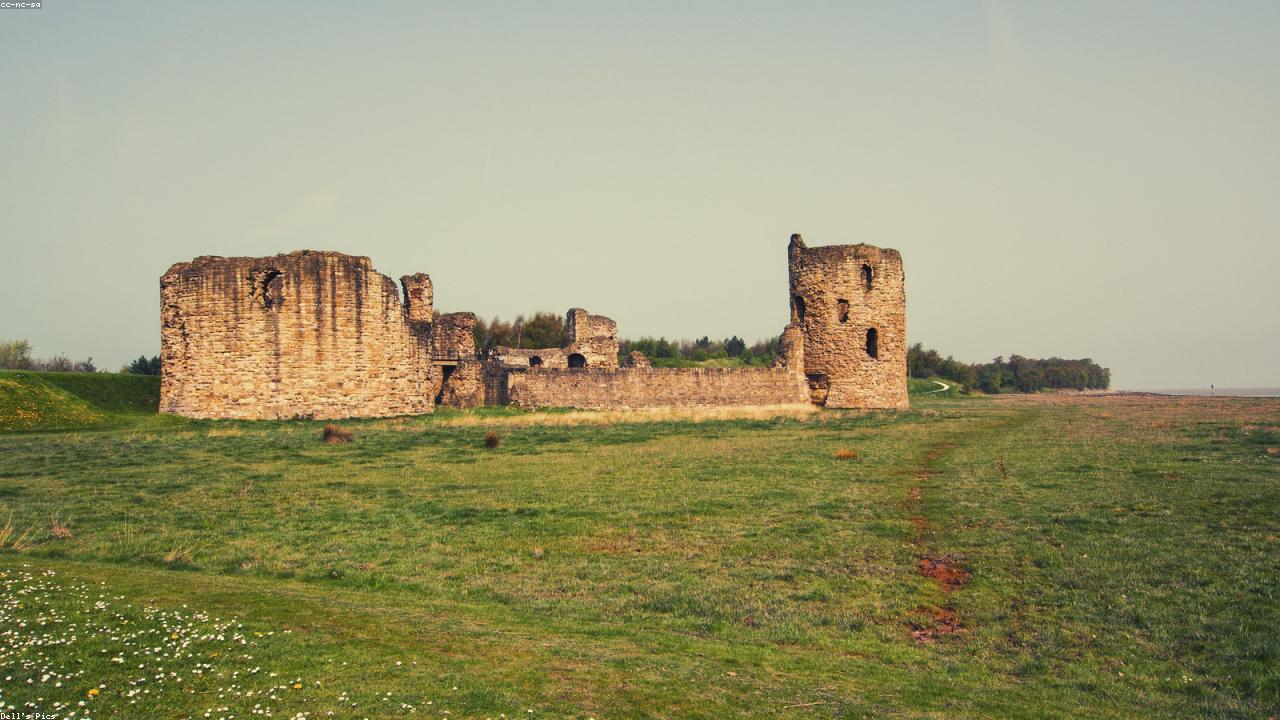
Flint (Y Fflint) is a market town on the southern shore of the Dee Estuary, built around the site of Edward I's first North Welsh castle — begun in 1277, six years before the more famous Iron Ring fortresses of Conwy, Caernarfon, Harlech, and Beaumaris. The castle ruins stand directly on the estuary shore, the great round donjon tower (a design unique among Welsh castles) still rising above the tidal margins of the Dee. At high tide the castle site is almost entirely surrounded by water; at low tide the vast sandbanks of the estuary are exposed, attracting tens of thousands of wading birds from September to March.
Flint is best known historically as the place where Richard II surrendered to Henry Bolingbroke in August 1399 — the meeting that ended the Plantagenet dynasty and brought the House of Lancaster to the English throne. Shakespeare dramatised this surrender in Richard II, placing it at Flint Castle. The town's industrial history — chemical works, copper smelting, wire drawing — is a less-celebrated chapter; Flint and the Flintshire coast were among the most industrialised parts of North Wales in the 19th century, their manufacturing importance now largely invisible.
Flint is exceptionally well connected by rail: the mainline Chester–Holyhead railway serves Flint Station, making it the most easily train-accessible of the North Wales castle towns from the north-west of England.
Find it on the map
Frequently asked questions
Flint Castle (built 1277) was the first of Edward I's North Wales castles — predating the more famous Iron Ring fortresses of Conwy, Caernarfon, Harlech, and Beaumaris (built 1283–1295) by six years. It has a unique design with a detached round donjon (great tower) that is unlike any other castle in Wales. The castle is famous as the site where Richard II surrendered to Henry Bolingbroke in August 1399 — an event that effectively ended the Plantagenet dynasty and brought Henry IV to the throne. Shakespeare dramatised the meeting in Richard II: "Down, down I come, like glistering Phaëton." The castle ruins are managed by Cadw and accessible free of charge.
Flint's position on the Dee Estuary gives it a distinctive character. The estuary shore is accessible via a coastal path from the castle, giving views across to the Wirral and Cheshire hills on the English bank. The Dee Estuary is an internationally important wetland for wading birds and wildfowl — particularly between September and April, when tens of thousands of knot, dunlin, oystercatcher, and redshank roost on the sandbanks. Point of Ayr (RSPB) at the far end of the Dee Estuary (5 miles) is one of the finest wader-watching sites in Wales. Flint town centre has a market (Saturday) and a modest range of shops and cafés.
Flint is exceptionally well served by public transport. The town has a mainline railway station on the Chester–Holyhead line — one of the busiest railway routes in Wales, with frequent services to Chester (approximately 15 minutes), Rhyl, Colwyn Bay, Llandudno Junction, and Holyhead. The A55 North Wales Expressway also passes near Flint, connecting it to the rest of North Wales. For visitors travelling from the north-west of England, Flint is the closest North Wales castle and heritage site to the M56/A55 junction — approximately 30 minutes from Chester. The proximity to the English border makes Flint a natural first stop on a North Wales itinerary from the east.
Yes — the Dee Estuary is one of the most important wetland sites in Britain and is designated as a Special Protection Area (SPA), RAMSAR site, and Site of Special Scientific Interest (SSSI). From Flint, the estuary shore gives views over the sandbanks and mudflats where tens of thousands of waders roost during autumn and winter — particularly knot (a species famous for its spectacular aerial murmurations), dunlin, oystercatcher, grey plover, and bar-tailed godwit. Peregrine falcons are regular, hunting the wader flocks. In summer the estuary is quieter for birds but the salt marsh and foreshore support breeding lapwing and redshank. The RSPB Point of Ayr reserve (5 miles from Flint along the estuary) is the dedicated birdwatching site for the area.
The Dee Estuary coastal path runs along the Flintshire shoreline from Flint northwards towards Gronant and Point of Ayr, giving a level waterside walk with extensive estuary views. From Flint Castle, the path follows the estuary shore north past Bagillt and Greenfield (where the ruins of Basingwerk Abbey are approximately 3 miles distant). The walk is flat and suitable for all abilities — the contrast between the industrial heritage of the Flintshire shore (the former chemical works and wire-drawing industries that made this area important in the 19th and early 20th centuries) and the internationally important wildlife of the estuary makes for an interesting juxtaposition. The Offa's Dyke Path long-distance trail starts at Prestatyn (8 miles) on the northern coast.