At a glance
Edward I's last and most mathematically refined Iron Ring castle (begun 1295) — the most technically perfect concentric castle ever built, yet never fully completed. The most accessible of the four UNESCO fortresses and the most affordable at adult £8.50 (April 2026).
About Beaumaris Castle
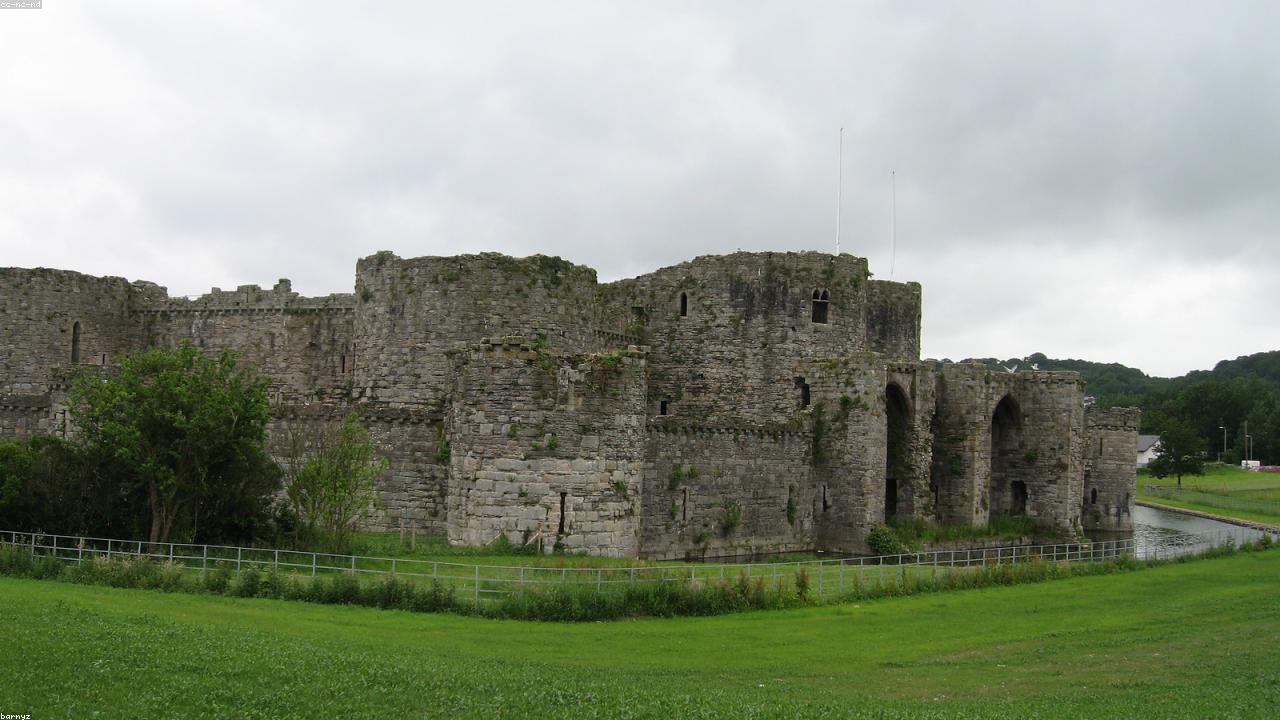
Beaumaris Castle was begun in 1295, twelve years after Conwy, Caernarfon and Harlech, as the final and most sophisticated of Edward I's Iron Ring fortresses on Ynys Môn (Anglesey). The site — flat, low-lying ground near the tidal strait — gave master builder James of St George the rare opportunity to design a castle without the constraints of natural terrain, resulting in the most geometrically perfect concentric castle ever built.
The design is a masterpiece of symmetry. The inner ward — a near-perfect octagon of high walls and six round towers — is surrounded by a lower outer ward with its own towers and gateways, in turn surrounded by a water-filled moat. Every point in the outer wall was covered by archers in the inner ward; every point in the moat was covered from the outer ward. An attacker breaching the outer wall would still face the full firepower of the inner defences.
Despite never being finished — work halted around 1330 and the towers were left at half their intended height — Beaumaris is still considered the pinnacle of medieval military architecture. UNESCO inscribed it alongside Conwy, Caernarfon and Harlech as part of the Castles and Town Walls of King Edward in Gwynedd World Heritage Site in 1986.
What to see at Beaumaris Castle
- The concentric walls — Walk the outer wall to appreciate the perfect geometry — note how every arrow loop in the inner wall covers the moat and outer ward below.
- The inner ward gatehouse — The twin-towered North Gate contains the main entrance passage — look up to see the murder holes and portcullis grooves still intact.
- The moat — The original water-filled moat is substantially intact — a level path runs around the perimeter and is fully accessible.
- The Chapel Tower — Contains the remains of the castle chapel with its original piscina and sedilia — small but remarkably preserved.
- Menai Strait views — The castle sits directly above the strait — on a clear day the Snowdonia mountains are visible across the water.
Visiting tips
Getting there
From the A55, cross the Britannia Bridge and follow the A545 through Menai Bridge to Beaumaris (4 miles from the bridge). The castle is in the town centre, signposted from the main road. Buses run from Bangor every 30 minutes. There is no direct train station — Bangor is the nearest, 9 miles away.
Combining with Conwy
Beaumaris and Conwy make an excellent same-day pair — 14 miles apart via the A55 (25 minutes). Visit Beaumaris in the morning and Conwy in the afternoon, or vice versa. A Cadw Explorer Pass covers both castles and saves money over individual admission.
Find it on the map
Frequently asked questions
Beaumaris is considered the most technically perfect concentric castle ever built because of the mathematical precision of its design — a perfectly symmetrical inner ward surrounded by an outer ward of nearly equal regularity, with perfectly aligned firing lines from every point. Each layer of defence could provide cover for the next. Architectural historians consistently rank it the pinnacle of medieval military engineering.
Cadw admission at April 2026 rates: Adult £8.50, Child £5.10, Family £23.50. Under-5s are free. Cadw members enter free. At £8.50 for adults, Beaumaris is the least expensive of the four Iron Ring castles — a significant discount on Caernarfon (£13.10) and Conwy (£13.10).
No. Beaumaris was begun in 1295 and work continued until around 1330, but the castle was never completed to its original design. The outer gatehouse towers were left at half-height and the planned chapel tower was never built. Despite this, it is still regarded as the masterwork of medieval military architecture because even in its incomplete state it demonstrates perfect concentric principles.
Yes — Beaumaris is the most accessible of the four Iron Ring castles. The site is largely flat, the moat path is level, and much of the lower ward is accessible. Some towers and upper wall walks involve steps, but the key areas of the castle can be experienced without significant climbing.
Beaumaris is 14 miles from Conwy via the A55 North Wales Expressway and the Britannia Bridge over the Menai Strait — approximately 25 minutes by car. This makes the two castles an excellent same-day combination, with a Cadw Explorer Pass covering admission to both.
The Victorian seaside town of Beaumaris has Beaumaris Court and Gaol (a separate Victorian prison museum), Beaumaris Pier, and excellent views across the Menai Strait to Snowdonia. The coastal path north to Penmon Point lighthouse (4 miles) is a fine walk. Plas Newydd (National Trust) is 5 miles west along the strait.