At a glance
The largest and most symbolically important of Edward I's four Iron Ring castles — unique polygonal towers, banded stone masonry, the Royal Welsh Fusiliers Museum and the site of the 1969 investiture of HRH Prince Charles. Adult £13.10 (April 2026).
About Caernarfon Castle
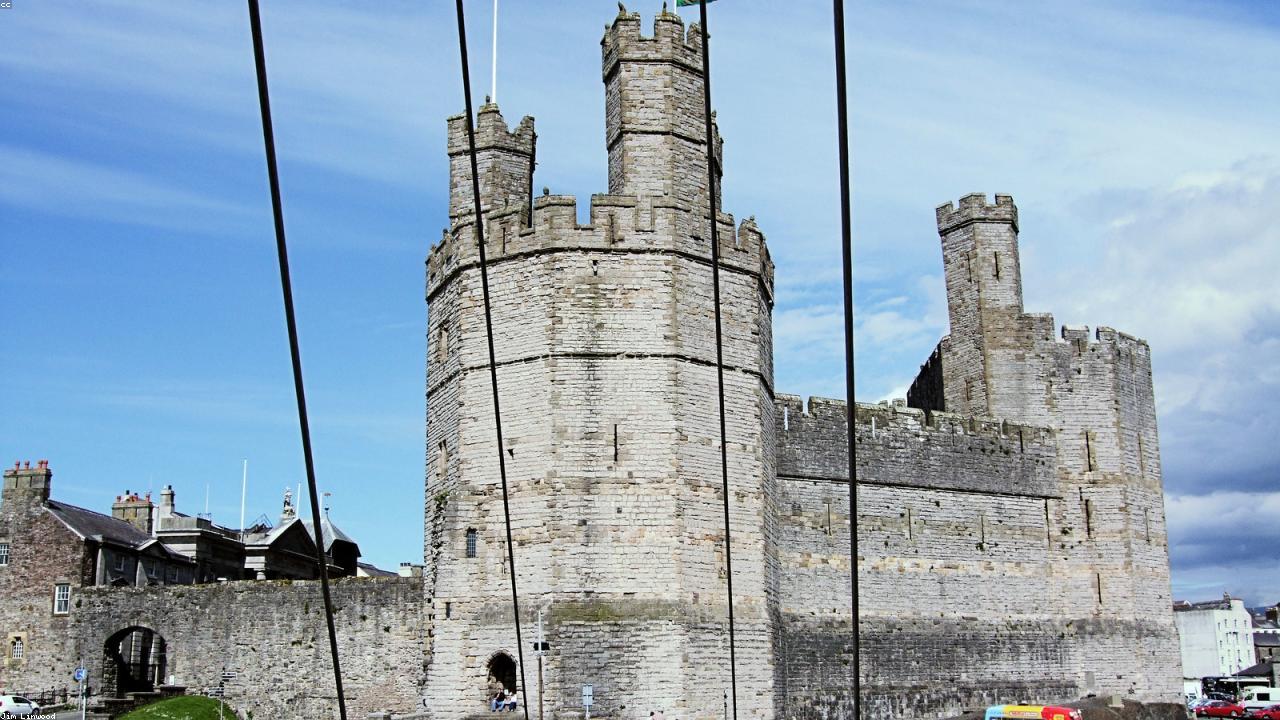
Construction of Caernarfon Castle began in 1283 under master builder James of St George and continued into the 1330s — making it the longest-built of the four Iron Ring castles. Edward I chose this site deliberately: it stood on the ruins of a Norman motte and a much earlier Roman fort (Segontium), and carried the prestige of an ancient royal Welsh residence. In 1301, Edward proclaimed his infant son — born at Caernarfon — the first English Prince of Wales here.
Unlike the round drum towers of Conwy, Harlech and Beaumaris, Caernarfon's towers are polygonal — multi-sided — and built with distinctive banded layers of warm buff sandstone alternating with grey limestone, a design echoing the walls of Constantinople. The Eagle Tower, at the castle's western end, is the grandest medieval tower in Wales and once housed the constable's residence. Its three turrets each originally displayed an eagle sculpture.
The castle received UNESCO World Heritage inscription in 1986 alongside Conwy, Harlech and Beaumaris as the Castles and Town Walls of King Edward in Gwynedd. Within the walls today, the Royal Welsh Fusiliers Museum covers the regiment's 300-year history — included in the Cadw admission price. The castle also houses good interpretation of the 1969 investiture of HRH Prince Charles as Prince of Wales.
What to see at Caernarfon Castle
- Eagle Tower — The grandest medieval tower in Wales — climb to the roof for views across the Menai Strait to Anglesey and Snowdonia.
- Royal Welsh Fusiliers Museum — Three floors of regimental history in Queen's Tower — weapons, uniforms, medals and memorabilia from 1689 to the present.
- The investiture site — The slate dais in the lower ward where Prince Charles was invested as Prince of Wales in 1969, watched by a global TV audience of 500 million.
- The town walls — A shorter circuit than Conwy's but still partly walkable, linking the castle to the medieval town layout.
- The Queen's Gate — An elaborate unfinished gatehouse on the south side — its planned stonework was never completed due to Edward I's campaigns in Scotland.
Visiting tips
Getting there
From Bangor, buses run every 20 minutes (journey ~20 min, 12 miles). The A487 coast road from Bangor runs directly into Caernarfon town centre. From the A55, exit at Junction 9 (Treborth) for the Britannia Bridge and Anglesey, or Junction 11 for the A487 to Caernarfon. The Welsh Highland Railway runs from Caernarfon station to Porthmadog via Beddgelert.
Combining with other attractions
Caernarfon pairs naturally with Beaumaris Castle (12 miles via the Britannia Bridge, ~25 min). Snowdon Mountain Railway departs from Llanberis, 8 miles east. The Welsh Highland Railway leaves from Caernarfon station — you can walk from the castle to the platform in 10 minutes.
Best time to visit
Summer mornings are busy with school and coach groups; aim to arrive at opening (09:30) or after 15:30. Spring and autumn weekdays are quietest. The castle is impressive in low winter light on clear days when Snowdonia is visible to the east.
Find it on the map
Frequently asked questions
Cadw admission at April 2026 rates: Adult £13.10, Child £7.80, Family £36.20. Under-5s are free. Cadw members enter free. A Cadw Explorer Pass (3-day ~£19 adult) covers Caernarfon plus other Cadw sites — good value if you're combining with Conwy, Harlech or Beaumaris.
Caernarfon is the only Iron Ring castle with polygonal towers rather than round drum towers, and the only one built with distinctive banded layers of differently coloured stone in its masonry. It is also the largest of the four and the most symbolically important — Edward I proclaimed his son the first English Prince of Wales here in 1301. The 1969 investiture of HRH Prince Charles was also held here.
Yes. The Royal Welsh Fusiliers Museum is housed within Queen's Tower inside the castle grounds and is included in Cadw castle admission. It covers the regiment's history from 1689 to the present day with weapons, uniforms, medals and regimental relics.
Allow 2–3 hours for a thorough visit — the castle is the largest of the four Iron Ring fortresses with multiple towers, the museum, and extensive wall walks. The town walls are shorter than Conwy's but still add 30 minutes if you choose to walk them.
Regular buses run from Bangor to Caernarfon every 20 minutes (journey ~20 min, 12 miles). There is no direct rail station in Caernarfon itself. From Llanberis (for Snowdon), buses also connect to Caernarfon. The Welsh Highland Railway departs from Caernarfon station for Porthmadog.
Yes. Caernarfon and Beaumaris (12 miles via A55 and Britannia Bridge) make an excellent half-day each — a comfortable day trip. Adding Conwy (24 miles north) extends the day significantly. With a Cadw Explorer Pass you can visit all four Iron Ring castles across 3 or 7 days without paying at each gate.