At a glance
Menai Suspension Bridge (LL59 5RR) — Thomas Telford's 1826 Grade I listed bridge linking Anglesey to mainland Wales across the Menai Strait. World's longest suspension bridge when opened. Free to cross (A5 road). Best viewed from the Belgian Promenade on the Anglesey bank. Open at all times.
About the Menai Suspension Bridge
Thomas Telford's Menai Suspension Bridge opened on 30 January 1826 — and at a single stroke solved a problem that had complicated the journey between London and Holyhead (and hence to Dublin) for centuries. The Menai Strait is a narrow but powerful tidal channel, its currents fast and its weather often rough: crossing it by boat was time-consuming and hazardous. Telford's bridge, with its main span of 176 metres and its roadway held 30 m above high water by iron chains, was the largest suspension bridge in the world when completed — a record that held until 1834.
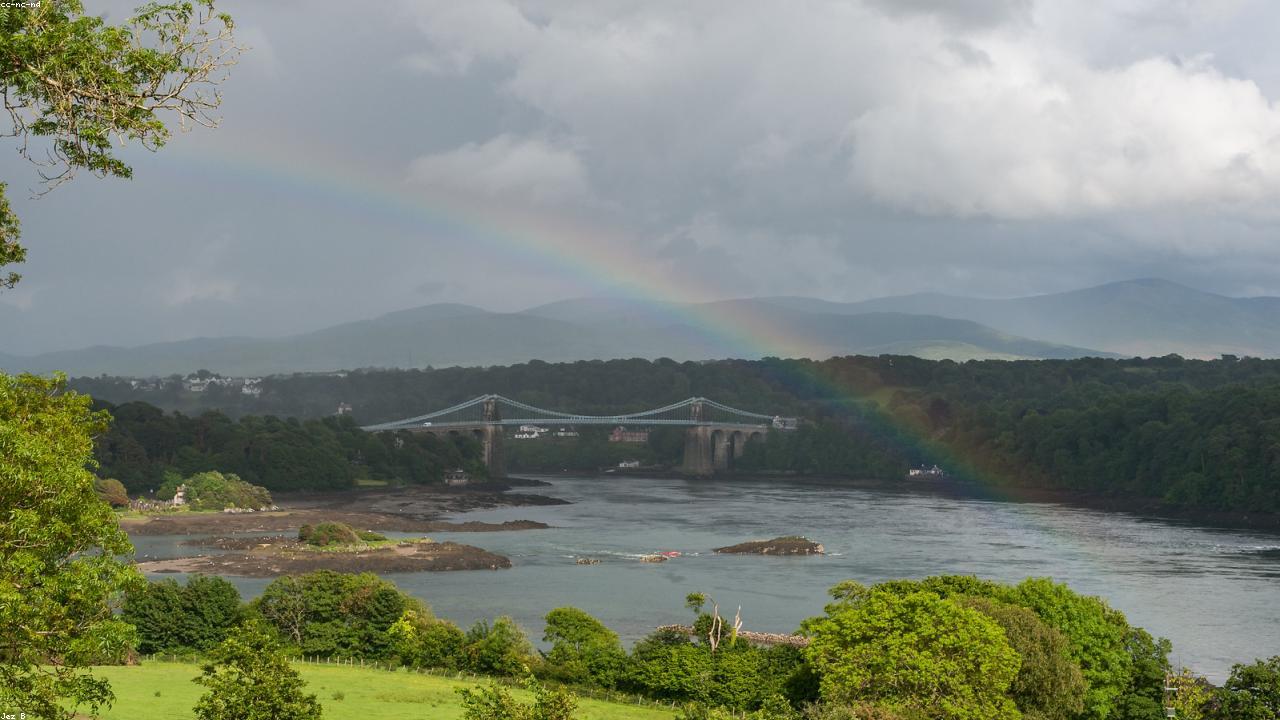
Two centuries later the bridge is still in daily use as the A5, its limestone towers and catenary chains as recognisable as ever. Grade I listed and a Scheduled Ancient Monument, it remains Telford's most celebrated work in Wales — alongside the Pontcysyllte Aqueduct — and one of the landmarks of early 19th-century engineering. The Belgian Promenade on the Anglesey bank gives the best view: the full span reflected in the Strait at high water, the mountains of Snowdonia behind on the mainland side.
Find it on the map
Frequently asked questions
The Menai Suspension Bridge was designed by Thomas Telford and opened on 30 January 1826. Telford (1757–1834) was the foremost civil engineer of his era — his other Welsh works include the Pontcysyllte Aqueduct (now a UNESCO World Heritage Site) and much of the A5 road from London to Holyhead. The Menai Bridge was built to improve the mail coach route from London to Holyhead (and hence to Dublin) — the Menai Strait had been a significant obstacle on the Irish packet route, requiring a boat crossing that was dangerous in rough weather. When opened, the Menai Bridge's main span of 176 metres made it the longest suspension bridge in the world, a record it held until 1834. The bridge is a Grade I listed structure and a Scheduled Ancient Monument.
The Menai Bridge was revolutionary in several ways. It was the first major iron suspension bridge in the world — demonstrating for the first time that suspension construction could carry the loads of a main road over a long span. Telford's solution to the problem of the Menai Strait (which has strong tidal currents, requiring the roadway to be 30 m above high water to allow the passage of tall sailing ships) required the new suspension technology since masonry arch bridges of sufficient height would have been enormously expensive. The main chains (originally wrought iron, replaced with steel in the 1930s) are still in place, and the bridge remains in daily use as the A5 road — a remarkable testament to Telford's design. The wrought-iron chain links, cast at ironworks in Shrewsbury, were floated out on rafts and lifted into position — a major engineering achievement of the 1820s.
The bridge is best seen from the Belgian Promenade on the Anglesey side — a footpath along the Strait shore that gives a view of the full span. The Menai Bridge town (on Anglesey, directly north of the bridge) has views from the foreshore. On the mainland side, the bridge is visible from the A5 approach road. The bridge itself can be walked across on foot (the footway is narrow alongside traffic, so care is needed) giving a view down to the Strait below. The strongest visual experience is from the water — the strait is accessible by kayak or open canoe — where the limestone towers and the chain catenary are seen from below. The viewpoint from Church Island (reached via a causeway from the Anglesey bank near the town) also gives good views of both the Menai Bridge and the Britannia Bridge upstream.
There are two bridges crossing the Menai Strait. The Menai Suspension Bridge (1826, A5 road) is Telford's structure — the older and more elegant of the two, with its distinctive chain suspension and limestone towers. The Britannia Bridge (opened 1850, rebuilt after a fire in 1970) carries the A55 road and the North Wales main railway line. Robert Stephenson's original Britannia Bridge was a rectangular box-section tubular iron construction — revolutionary in its own way (and influencing bridge design for decades) but less visually dramatic. The 1970 rebuilding replaced the tubes with a conventional steel arch, now carrying both road and rail on separate decks. The two bridges are approximately 1 mile apart and can both be seen from Church Island or the Belgian Promenade.
Menai Bridge town (Porthaethwy) on the Anglesey side of the bridge is a pleasant small town with cafes, restaurants, and the Oriel Môn Gallery. The Belgian Promenade walkway gives a fine Menai Strait waterfront. Church Island — connected to the shore by a causeway — has an ancient church and gives views of both the Telford and Stephenson bridges. Plas Newydd (National Trust) is approximately 2 miles south-west, on the Menai shore — it has an extensive garden, a Rex Whistler mural, and ferry access to the mainland at certain times. The town is a useful base for exploring Anglesey, being directly connected to Bangor by the A5 (3 miles) and by bus services.