At a glance
Two historic lighthouses (Tŵr Bach 1800, Tŵr Mawr 1845) on a tidal island off Newborough Beach — reached by a free 1.5-mile walk through Newborough Forest and across the sand. Also the ruins of St Dwynwen's church (Welsh patron saint of lovers). Newborough car park LL61 6SG.
About Ynys Llanddwyn — Llanddwyn Island
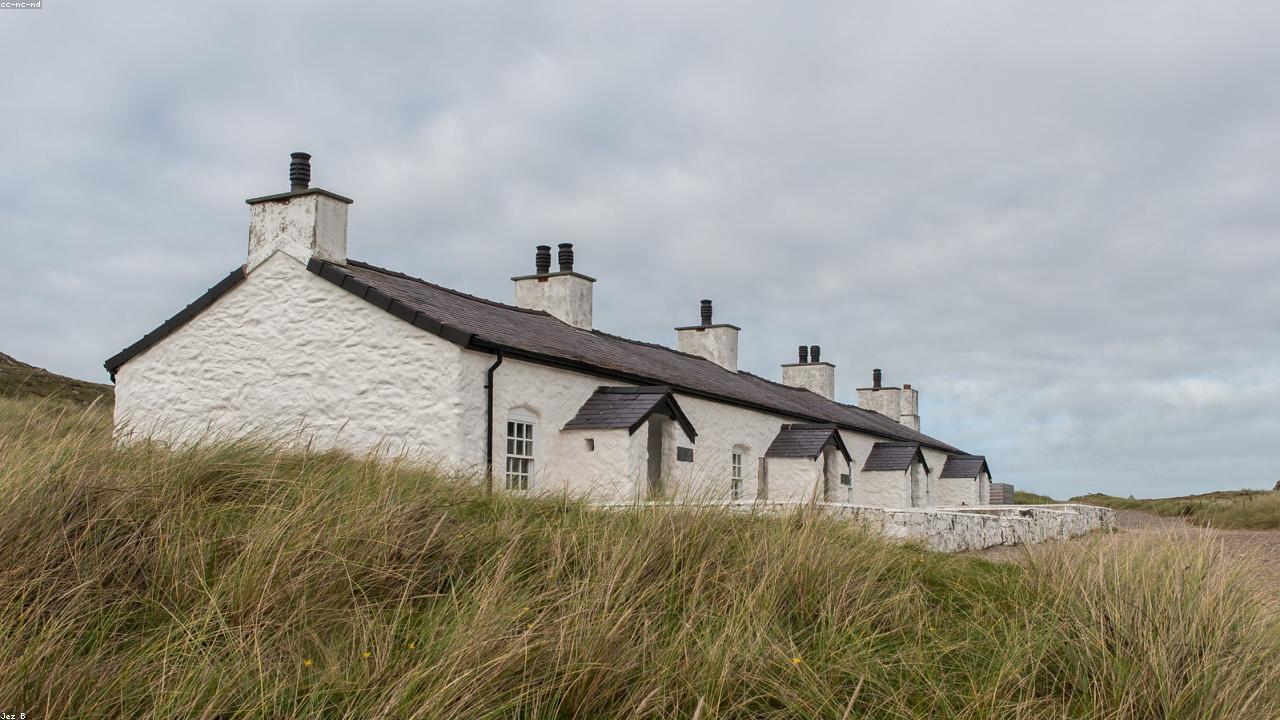
Llanddwyn Island (Ynys Llanddwyn) is a tidal peninsula off the southern end of Newborough Beach on Anglesey — connected to the main beach by a sandy causeway that is passable on foot for most of the tidal cycle. The island is small, rocky and ancient: the ruined church of St Dwynwen (5th-century patron saint of Welsh lovers) stands among the maritime grass; two historic lighthouses guard the mouth of the Menai Strait; and a row of whitewashed pilot cottages faces east across Caernarfon Bay toward the mountains of Snowdonia.
The two lighthouses tell the story of navigational improvement in the 19th century. Tŵr Bach — a small, conical whitewashed tower built in 1800 — was an inadequate daymark that proved insufficient for the volume of maritime traffic using the Menai Strait. It was supplemented in 1845 by Tŵr Mawr, a more substantial lighthouse resembling a windmill tower, which operated until decommissioning in 1975. Both structures are now Scheduled Ancient Monuments; they can be examined from outside and are among the most photographed lighthouse pairs in Wales.
The island is reached by walking 1.5 miles from the Newborough Forest car park (LL61 6SG) through the Corsican pine forest planted in the 1950s and then across the wide beach. There is no formal path on the beach section. Access is free; the car park is charged by Natural Resources Wales. On the island itself, the view east across Caernarfon Bay to the full arc of Snowdonia mountains is one of the finest in Anglesey — the peaks of the Nantlle Ridge, Snowdon, and the Rivals (Yr Eifl) visible above the water on clear days.
Find it on the map
Frequently asked questions
Llanddwyn Island (Ynys Llanddwyn) has two historic lighthouses. Tŵr Bach ("little tower") is the older of the two — a small, conical daymark tower built in 1800, originally whitewashed to act as a navigational mark for ships entering the Menai Strait. Tŵr Mawr ("big tower") is a taller, more substantial lighthouse built in 1845 to replace the inadequate earlier structure, resembling a traditional Welsh windmill tower. Tŵr Mawr was decommissioned in 1975 when the nearby Abermenai Point buoy was established; it is now a Scheduled Ancient Monument and can be examined from outside.
Dwynwen was a 5th-century Welsh princess — daughter of the legendary King Brychan — who, according to tradition, fled to Llanddwyn Island after a broken love affair and became a hermit. She is venerated as the patron saint of Welsh lovers, and her feast day on 25 January (Dydd Santes Dwynwen) is the Welsh equivalent of Valentine's Day. The ruins of her church (Eglwys Santes Dwynwen) stand on the island — a small 16th-century structure built on the site of her original cell — and the island retains a particular atmosphere of isolation and romance.
Llanddwyn Island is technically a tidal peninsula connected to the main beach by a narrow causeway of sand, only completely cut off by the highest spring tides. For most of the year it can be walked to freely at any state of the tide, but visitors should check local tide tables if visiting around spring tides. The walk from the Newborough Forest car park (LL61 6SG) through the forest and along the beach to the island is approximately 1.5 miles (30–45 minutes). No formal path — the route is across the beach.
Beyond the two lighthouses and St Dwynwen's church ruins, the island has a row of whitewashed pilot cottages — home to the pilots who guided ships through the Menai Strait — now used by Natural Resources Wales. The island's rocky western shore faces the open Irish Sea and gives views north to the Great Orme and south toward the Llŷn Peninsula. On the eastern side, the view across Caernarfon Bay to Snowdonia is one of the finest in Wales — the mountains of the Nantlle Ridge, Snowdon and the Rivals (Yr Eifl) forming a complete arc above the water.
From the Newborough Forest car park (LL61 6SG), the walk to Llanddwyn Island is approximately 1.5 miles (2.5 km) through the pine forest and then across the beach. Allow 30–45 minutes each way on foot — longer with young children. The beach section has no formal path and involves walking on sand, which can be harder going than a track. Total time for the return trip including time on the island is typically 2–3 hours. The forest section is well-tracked and clearly signed.
Llanddwyn Island is outstanding in every season. Spring and early summer bring the best light for photography and the views of Snowdonia are clearest before summer haze. The beach at Newborough is busy in July and August but the island itself retains a sense of space. Autumn gives exceptional quality of light and often very clear views. Winter visits on calm days are particularly striking — the island feels genuinely remote and the ruins of Dwynwen's church have an appropriate desolation. For the feast of St Dwynwen (25 January), some visitors make the winter pilgrimage across the beach.