At a glance
One of Britain's most dramatically sited lighthouses — a white tower on an isolated sea stack off Holy Island, reached by 400 steps and a suspension bridge. Lighthouse tours adult ~£6 (seasonal, Easter–Oct). The RSPB seabird reserve above is free year-round. LL65 1YH.
About South Stack Lighthouse
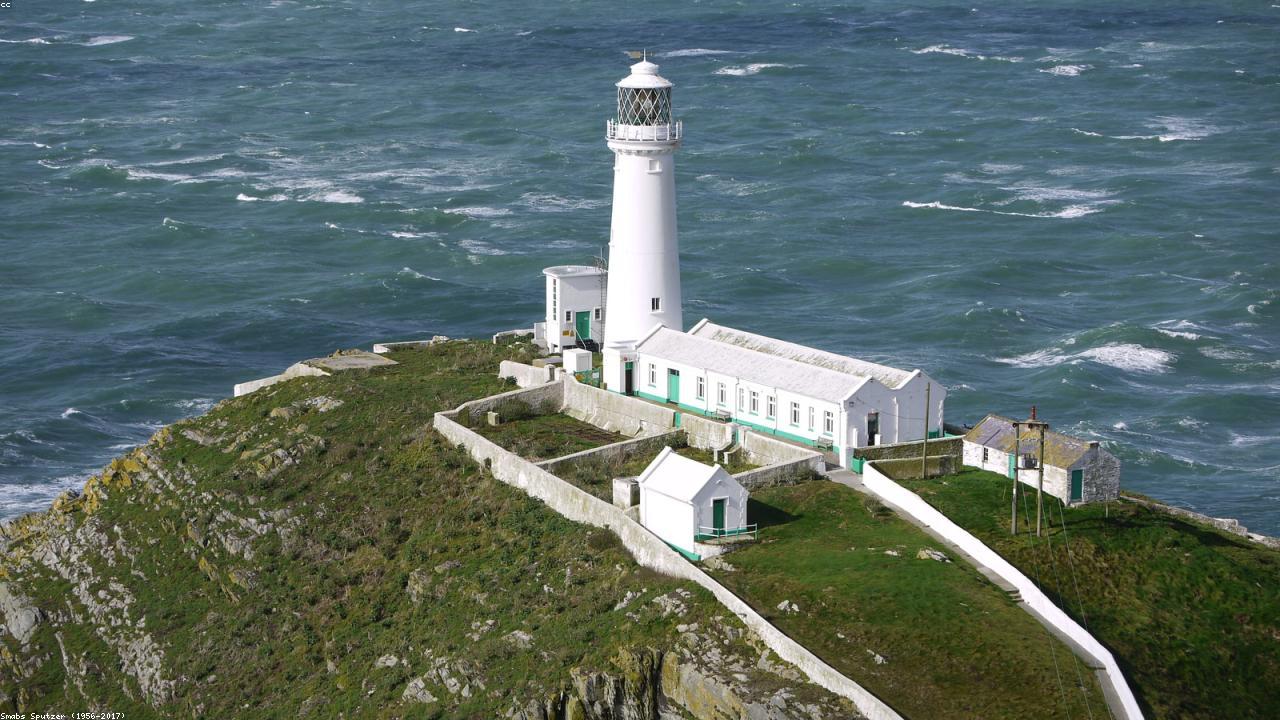
South Stack Lighthouse stands on an isolated sea stack at the northwestern tip of Holy Island — separated from the mainland cliff by a narrow tidal channel and reached by 400 steps cut into the rock face and a suspension bridge. Built in 1809 to warn ships of the rocks on the approach to Holyhead Harbour, it is one of the most dramatically sited lighthouses in Britain: 28 metres of white masonry rising from bare rock, with the Irish Sea visible in three directions and the Snowdonia mountains to the southeast.
Trinity House opens the lighthouse for visitor tours seasonally, typically Easter to October. The tour includes the engine room, the living quarters of the former lighthouse keepers (the light was automated in 1984) and the lantern room with its optic — still operational, still guiding ships on the Dublin route 200 years after it was first lit. The descent and re-ascent of the 400 steps is the central physical experience of the visit.
Above the descent, the clifftop area forms part of the RSPB's South Stack reserve — home to approximately 4,000 pairs of breeding seabirds including razorbills, guillemots, kittiwakes, puffins and fulmars. Ellin's Tower, a Victorian folly on the cliff edge, is now the RSPB's free visitor centre with telescopes and live CCTV from the nesting ledges. Choughs — the red-billed crow that is the symbol of Wales — are reliably present on the cliffs year-round. The lighthouse and the RSPB reserve are independent attractions on the same clifftop, and both reward a half-day visit.
Find it on the map
Frequently asked questions
South Stack Lighthouse was completed in 1809, designed by Daniel Alexander for Trinity House. It was built to warn ships of the dangerous rocks at the northwestern tip of Holy Island on the approach to Holyhead Harbour — the main port for the Dublin packet service. The lighthouse stands 28 metres tall, and its light has a range of 24 nautical miles. It was automated in 1984, removing the need for a resident keeper. Trinity House opens it for seasonal visitor tours.
The lighthouse is reached by descending approximately 400 steps cut into the cliff face and crossing a suspension bridge over the narrow channel that separates the stack from the mainland cliff. The descent takes approximately 15 minutes; the ascent is more demanding. There is no alternative route for those with mobility difficulties — the clifftop above (and the RSPB reserve at Ellin's Tower) is accessible without descending and provides good views of the lighthouse from above. The car park is at LL65 1YH, 4 miles from Holyhead.
The cliffs around South Stack Lighthouse support around 4,000 pairs of breeding seabirds including razorbills, guillemots, kittiwakes and fulmars. Puffins breed on the cliff slopes from April to July. Choughs — the red-billed crow that is the symbol of Wales — are seen year-round on the cliffs. Peregrine falcons nest on the cliff faces and can sometimes be watched from Ellin's Tower, the RSPB's clifftop visitor centre immediately above the lighthouse descent. The RSPB provides live CCTV feeds from the nesting ledges.
Ellin's Tower is a small Victorian folly on the clifftop above South Stack, now operated by the RSPB as a free visitor centre with telescopes and live CCTV feeds from the seabird nesting ledges. It was built in the 1860s by W.O. Stanley as a summer house for his wife, Ellin, and has panoramic views of the cliffs and the Irish Sea. The RSPB centre is free to visit and is staffed by volunteers during the seabird season (April–July).
South Stack occupies the northwestern tip of Holy Island — the westernmost point of Anglesey and one of the most exposed coastal positions in Wales. On clear days the view from the clifftop encompasses the full sweep of the Irish Sea, the Wicklow Mountains of Ireland to the west (approximately 60 miles), the Isle of Man to the north, the Great Orme and the North Wales coast to the east, and the mountains of Snowdonia to the southeast. The sunsets from the cliffs are exceptional.
Yes — the clifftop car park, Ellin's Tower (RSPB visitor centre) and the broad clifftop paths of the South Stack area are all accessible without descending the 400 steps. The views from the clifftop are outstanding and include a clear view down to the lighthouse. For visitors who cannot manage the steps — or those with children in pushchairs — the clifftop provides an excellent experience of the site. The RSPB centre at Ellin's Tower is free and staffed in season.